
Healthcare AI can analyze medical data, identify patterns, generate recommendations, and automate workflows, but healthcare organizations cannot treat every AI output as an automatic decision.
Human oversight in healthcare AI provides the control layer between AI output and consequential healthcare action. It determines when a clinician should review an AI recommendation, when an organization should intervene, and how AI performance should be monitored after deployment.
This guide explains how organizations can design human-in-the-loop healthcare AI systems, establish risk-based oversight, monitor AI performance, and build responsible AI governance.
Contact Us to Discuss Your Healthcare Technology Needs
What Is Human Oversight in Healthcare AI?
Why Does Human Oversight Matter in Healthcare AI?
AI Can Make Errors
AI systems can produce incorrect predictions, recommendations, summaries, or generated information.
Generative AI can also produce plausible-sounding information that is inaccurate. This makes human review particularly important when AI-generated content could influence clinical decisions.
A clinician reviewing an AI output can question an unexpected recommendation rather than treating the system’s result as automatically correct.
Healthcare Decisions Require Context
A patient’s health cannot always be represented by structured data alone.
Two patients with similar clinical measurements may have different medical histories, circumstances, preferences, or treatment requirements.
Human professionals can bring contextual knowledge and clinical judgment that may not be fully represented in an AI model.
AI Can Reflect Bias in Data
AI systems learn patterns from data. If the underlying data is incomplete, unrepresentative, or affected by historical disparities, the resulting system may produce less reliable outcomes for certain populations.
Human oversight can help identify unusual patterns, investigate potential disparities, and determine whether an AI system is appropriate for a particular population or use case.
The FDA’s transparency principles for machine-learning-enabled medical devices specifically highlight the importance of information that helps users identify risks, understand performance, and evaluate issues such as bias and health equity.
AI Performance Can Change Over Time
An AI model that performs well during validation may behave differently when deployed in another environment or when patient populations, workflows, or data patterns change.
That makes continuous monitoring important.
Human oversight provides a mechanism for healthcare teams to review performance, investigate unexpected results, and determine when a model needs to be adjusted, retrained, restricted, or removed.
Human Oversight vs. Fully Automated Healthcare AI
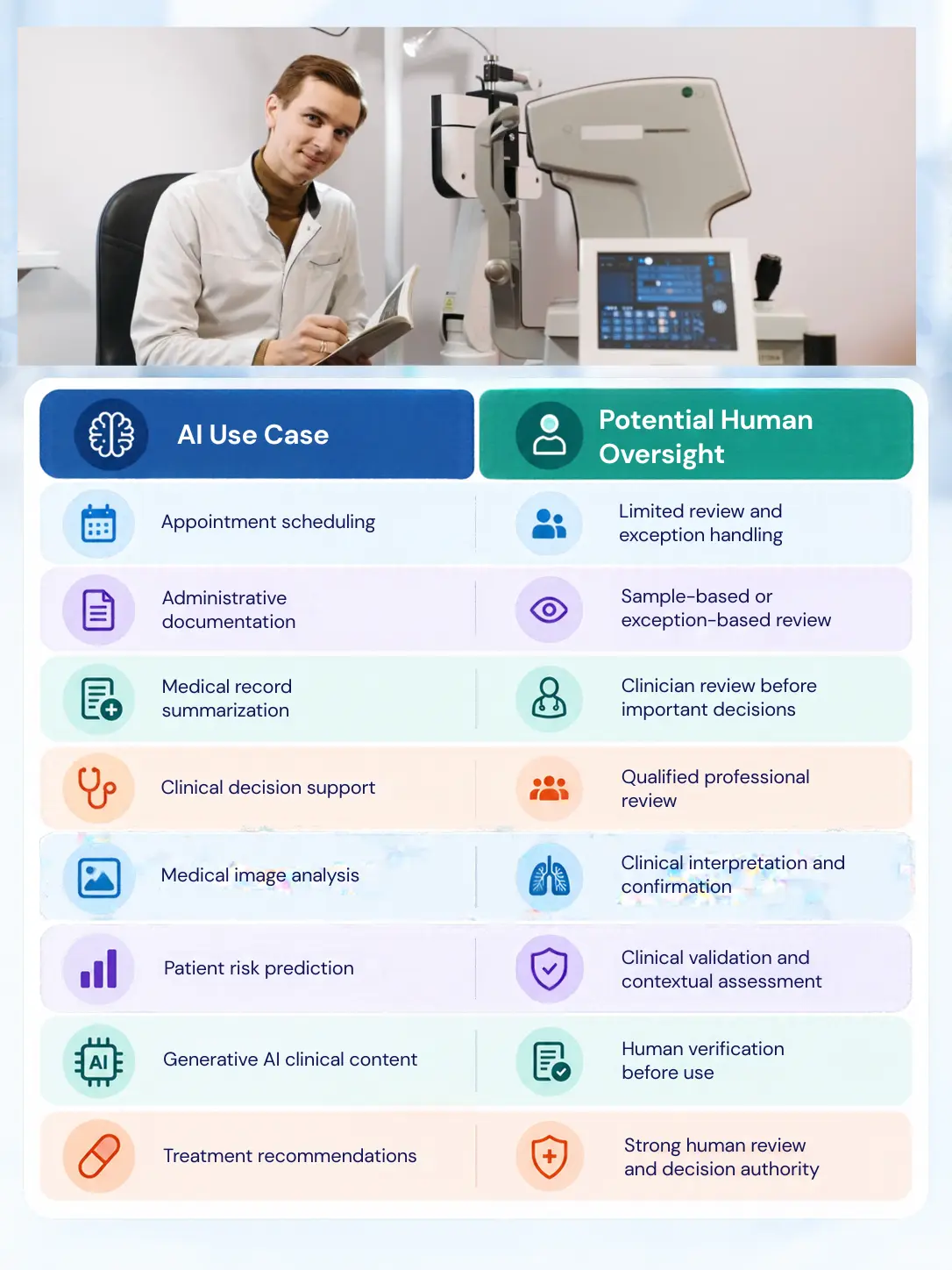
The goal is not to make every AI workflow slow. Instead, organizations should design risk-based human oversight.
Ready to Put AI to Work in Healthcare?
Get expert guidance on building secure, scalable, and responsible AI solutions for your healthcare organization.
Where Is Human Oversight Used in Healthcare AI?
Human oversight can be incorporated throughout the AI lifecycle, not only after an AI system has been deployed.
Healthcare professionals should have opportunities to contribute to the design of AI systems.
Clinical users understand real-world workflows, terminology, patient interactions, and operational challenges. Their input can help technology teams build AI tools that solve genuine problems rather than creating additional complexity.
The FDA’s guidance on AI-enabled medical devices emphasizes lifecycle management, including considerations spanning development, implementation, monitoring, and maintenance.
Data Preparation and Validation
Human experts can review training and validation data for quality, relevance, completeness, and representativeness. This matters because an AI system can only be as reliable as the processes surrounding its data and deployment.
Healthcare organizations should ask:
- Is the data relevant to the intended population?
- Are important groups underrepresented?
- Are there missing or inconsistent data points?
- Is the data being used for the same purpose for which it was collected?
- Has the model been validated using appropriate data?
Model Validation
Before deploying an AI model, organizations should evaluate whether it performs as expected. Validation can involve technical testing as well as clinical and operational review.
Healthcare professionals can assess whether model outputs are clinically meaningful and whether the system fits the workflow in which it will be used.
AI Deployment
Human oversight should also be incorporated into the actual user experience. For example, a clinical AI dashboard could provide the AI-generated recommendation, confidence or supporting information where appropriate, relevant patient data, model limitations, an option to accept or reject the recommendation, escalation mechanisms, and documentation of human review.
The objective is to make AI understandable and actionable rather than presenting an unexplained output.
Continuous Monitoring
AI governance does not end when the software goes live. Healthcare organizations should monitor accuracy and performance, false positives and false negatives, unexpected outputs, user feedback, changes in data quality, differences across patient populations, workflow impact, security and privacy risks, model drift, or performance degradation.
How Can Healthcare Organizations Implement Human Oversight?
Human oversight should not be treated as an afterthought. It should be built into the AI architecture, workflows, governance model, and user experience from the beginning.
Here is a practical framework.
Define the AI’s Intended Purpose
Start with a simple question: What exactly is the AI system supposed to do? Is it summarizing medical records, identifying patterns in imaging, predicting risk, supporting administrative work, or generating patient communication?
A clearly defined purpose makes it easier to determine the appropriate level of human involvement.
Classify the Risk
Not every AI application requires the same level of oversight. Organizations can categorize applications based on factors such as:
- Potential impact on patient safety
- Whether the output influences clinical decisions
- Sensitivity of the data
- Potential for bias
- Degree of automation
- Ability to reverse an AI-driven action
Higher-risk applications generally require stronger human review, escalation, documentation, and monitoring.
Define Human Responsibilities
Healthcare organizations should clearly establish:
- Who reviews the AI output?
- What should they review?
- When should they intervene?
- What happens when the AI appears wrong?
- Who has authority to override the system?
Without clearly defined responsibilities, an organization can have an AI system technically “under human oversight” while users still treat its recommendations as automatic decisions.
Build Explainability Into the User Experience
A healthcare professional needs enough information to understand an AI output and determine whether it should be trusted in context.
The FDA’s transparency principles emphasize providing relevant information to users in ways that support safe and effective use, risk management, informed decision-making, and detection of performance problems.
Explainability does not always mean revealing every technical detail of a model.
It means giving the intended user meaningful information about what the system does, where its output comes from, its limitations, and how the output should be interpreted.
Create Override and Escalation Mechanisms
A human reviewer should have a practical way to challenge the AI. For example:
AI recommendation → Human review → Accept / Modify / Reject → Document decision
If a system does not provide a clear mechanism to disagree with its output, human oversight becomes largely theoretical.
Monitor and Improve
AI governance should be continuous. Organizations should collect feedback from clinicians and other users and use that information to improve the technology and workflow.
The NIST AI Risk Management Framework provides a voluntary framework for organizations to manage AI risks and incorporate trustworthiness considerations throughout the design, development, deployment, and evaluation of AI systems.
What Does Responsible AI in Healthcare Look Like?
Responsible healthcare AI combines technology with governance, clinical expertise, transparency, security, and continuous monitoring.
A responsible AI implementation should answer five basic questions:
- Is the AI appropriate for this use case?
The technology should address a clearly defined healthcare problem.
- Has it been appropriately validated?
Performance should be evaluated against relevant requirements and populations.
- Can humans understand and challenge its outputs?
Users should have meaningful information and mechanisms to question AI results.
- Is the system continuously monitored?
Performance, safety, bias, security, and workflow impact should be reviewed after deployment.
- Is there clear accountability?
Organizations should know who is responsible for oversight, escalation, documentation, and corrective action.
These principles align with the broader direction of healthcare AI governance. WHO recommends that AI in health prioritize autonomy, safety, transparency, accountability, equity, and sustainability.
Human Oversight Is Not About Slowing Down AI
One common concern is that human review could eliminate the efficiency benefits of AI. That does not have to be the case. The objective is to determine where human judgment adds the most value.
AI can handle large volumes of information, identify patterns, automate repetitive processes, and surface potentially important information. Humans can then focus their attention on interpretation, exceptions, complex cases, ethical considerations, and decisions requiring clinical judgment.
Think of AI as a highly capable assistant, not an independent decision-maker. For example, instead of asking a physician to manually review thousands of data points, an AI system can identify relevant patterns and present them for review. The physician can then spend more time evaluating the patient’s individual situation.
This approach can create a human-AI partnership in which technology improves efficiency while people retain meaningful control.
The Future of Human Oversight in Healthcare AI
As healthcare AI becomes more capable, human oversight will likely become more sophisticated rather than disappearing. Future healthcare systems may combine:
- AI-powered clinical decision support
- Generative AI assistants
- Predictive analytics
- Automated documentation
- Medical imaging AI
- Healthcare interoperability
- Real-time monitoring
- AI-powered patient engagement
- Cloud-based healthcare platforms
These technologies can create significant opportunities, but they also increase the importance of governance.
The WHO’s 2025 guidance on large multimodal models highlights the expanding potential of generative AI across healthcare and emphasizes the need to address associated ethical and governance considerations.
Research is also examining how human-in-the-loop approaches can be incorporated throughout the lifecycle of AI-enabled clinical decision support systems. A recent systematic scoping review found that clinician involvement has often focused on early development stages, while reporting of ongoing oversight and maintenance has been much less common.
That points to an important shift for healthcare organizations: Human oversight should extend beyond AI development into deployment, monitoring, maintenance, and continuous improvement.
Looking to Build Responsible AI Solutions for Healthcare?
Healthcare AI requires more than an AI model. It requires the right combination of AI engineering, healthcare software development, interoperability, cloud infrastructure, data engineering, security, and quality engineering.
At Genius Bytes, we help healthcare organizations build and modernize technology solutions with a focus on connected, scalable, and AI-enabled healthcare systems. From healthcare AI solutions and AI consulting to interoperability and cloud modernization, the right technology architecture can help turn AI opportunities into practical solutions.
Contact Genius Bytes to discuss your healthcare AI project and explore how we can help you build secure, scalable, and human-centered healthcare technology.
FAQs
Human oversight ensures that people can review, validate, and override AI outputs when necessary. In healthcare, it helps maintain accuracy, accountability, and patient safety.
Yes. Healthcare organizations should establish appropriate human oversight to review AI outputs, manage risks, and ensure that important decisions remain under qualified human control.
The level of oversight should depend on the AI system's risk and intended use. Low-risk applications may need limited review, while high-risk clinical applications require stronger human oversight, including review, intervention, and the ability to override AI outputs.
The main role of AI in healthcare is to support professionals by analyzing data, identifying patterns, automating routine tasks, improving workflows, and assisting clinical decision-making.
Human oversight helps identify inaccurate AI outputs, reduce potential bias, and ensure recommendations are evaluated within the patient's clinical context. It also supports safer and more accountable AI use.
Human-in-the-loop AI involves healthcare professionals directly reviewing and evaluating AI-generated outputs. They can approve, modify, reject, or override recommendations when necessary.
AI can assist doctors by analyzing data, identifying patterns, and supporting clinical decisions. However, human clinical judgment remains essential for understanding patient context and making important healthcare decisions.
Organizations can reduce AI risks by validating AI systems, maintaining data quality, protecting sensitive information, monitoring performance, addressing potential bias, and implementing appropriate human oversight.
AI governance is a framework of policies, processes, and controls for managing healthcare AI responsibly. It covers areas such as safety, privacy, security, transparency, accountability, compliance, and human oversight.
Human oversight allows healthcare professionals to review AI outputs, identify errors or unexpected results, and intervene when necessary. This helps improve patient safety and supports responsible AI implementation.