
Healthcare interoperability enables different healthcare systems to exchange and use patient data seamlessly. Standards such as HL7 and FHIR, along with EHR integration and secure APIs, help healthcare organizations improve data exchange, care coordination, and patient access to information.
In 2026, understanding these technologies is essential for building connected, secure, and scalable healthcare solutions. But where should an organization start? Is FHIR replacing HL7? How do EHR systems exchange patient data? And what should healthcare leaders consider before investing in an interoperability solution?
This guide explains HL7, FHIR, EHR interoperability, key US regulations, and best practices for implementing effective healthcare data exchange.
Planning a Healthcare Integration Project?
What Is Healthcare Interoperability?
Healthcare interoperability is the ability of different health information systems to exchange data and use that information meaningfully, regardless of where the data was originally created or stored.
For example, when a patient visits a specialist, the specialist may need access to the patient’s medication list, laboratory results, allergies, and previous diagnoses. Interoperability helps make that information available through connected healthcare systems, subject to applicable permissions and access policies.
Without effective interoperability, healthcare teams may need to request records manually, enter information more than once, or work with incomplete patient histories.
How healthcare data interoperability works
Healthcare interoperability typically involves several connected components:
- Data standards: Define how information is structured and represented.
- Integration interfaces: Enable systems to send, receive, or request data.
- Data mapping: Translates information between different formats and terminologies.
- Identity management: Helps match records to the correct patient.
- Security and governance: Define who can access information, for what purpose, and under which conditions.
- Validation and monitoring: Help detect incomplete data, failed transactions, and integration errors.
Consider a laboratory sending test results to a hospital’s electronic health record (EHR). The laboratory and hospital may use different software, but a properly implemented interface can transmit the result in a format the receiving system understands.
The important distinction is that successful data transmission does not automatically mean successful interoperability. The receiving system must also interpret the information correctly and make it available within the appropriate clinical workflow.
Why interoperability matters for healthcare organizations
Healthcare interoperability helps organizations connect fragmented systems and make patient information accessible when and where it is needed. Without effective data exchange, healthcare teams may face incomplete records, duplicate data entry, delayed information, and disconnected workflows.
Key benefits of healthcare interoperability include:
- Improved care coordination: Helps healthcare professionals access relevant patient information across care settings.
- Better data accessibility: Makes it easier for authorized users to retrieve information from connected systems.
- Reduced manual work: Minimizes repetitive data entry and manual record transfers.
- More informed decisions: Supports clinical decisions with relevant, timely, and consistent patient data.
- Scalable digital healthcare: Enables integration between EHRs, laboratories, pharmacies, patient apps, and emerging healthcare technologies.
Helps healthcare organizations connect the information needed for analytics and AI applications, subject to appropriate data quality and governance controls.
The four levels of healthcare interoperability
Healthcare interoperability is commonly explained through four levels.
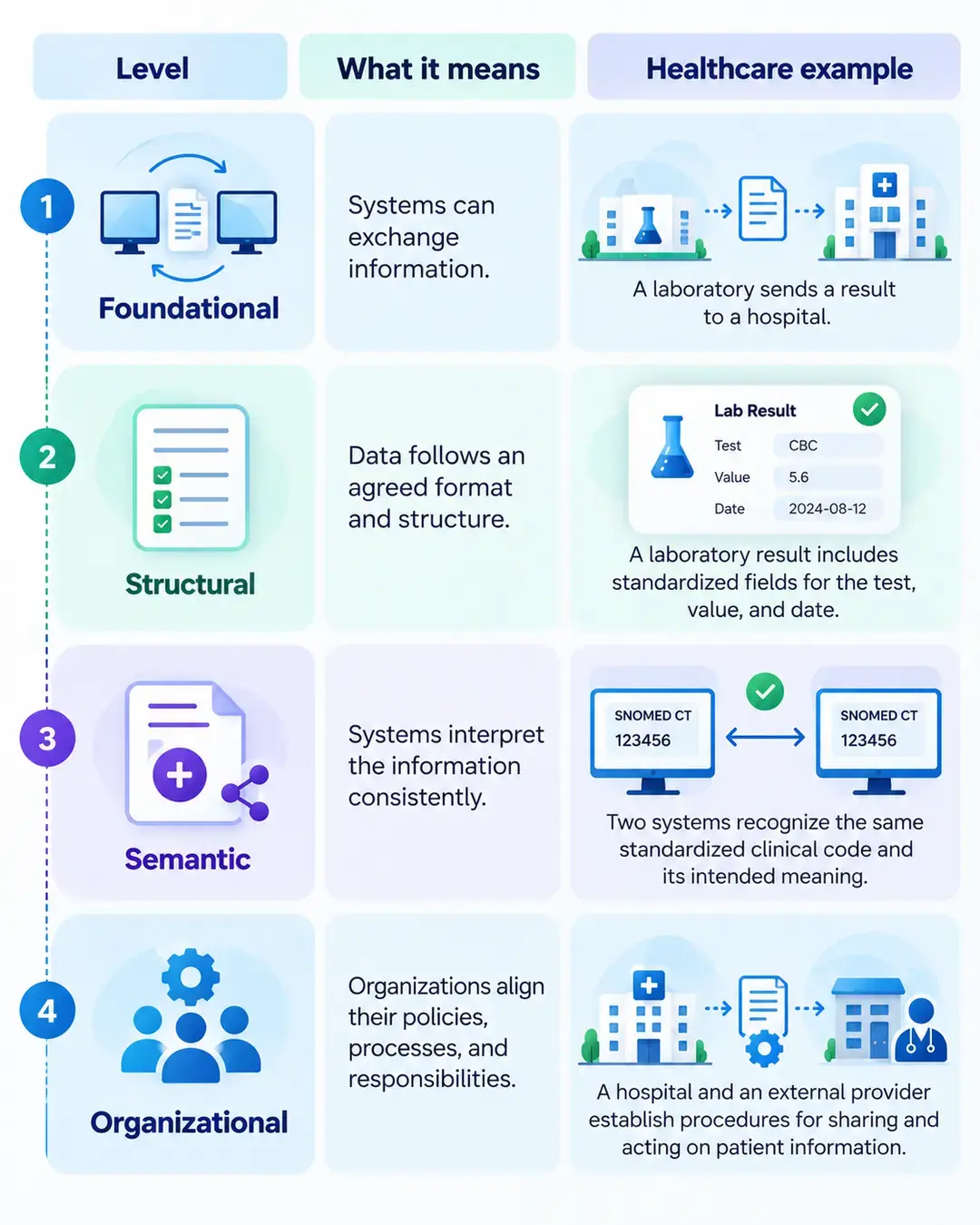
Each level builds on the previous one. A technically connected system may still create problems if data structures differ, clinical terminology is inconsistent, or organizations have not agreed on how information should be handled.
For healthcare leaders, the goal should be to achieve meaningful interoperability, not simply connect more systems.
What Are Healthcare Interoperability Standards?
Healthcare interoperability standards establish common rules for representing, exchanging, and interpreting health information.
They help different software applications communicate without requiring every organization to develop an entirely unique interface for every connection. Several standards play important roles in healthcare data exchange, but they do not all perform the same function.
What is HL7?
Health Level Seven International (HL7) develops standards for exchanging and integrating electronic health information. HL7 standards are used across healthcare environments to support clinical messaging, document exchange, and other interoperability workflows.
Two important HL7 standards are HL7 Version 2 (HL7 v2) and Fast Healthcare Interoperability Resources (FHIR).
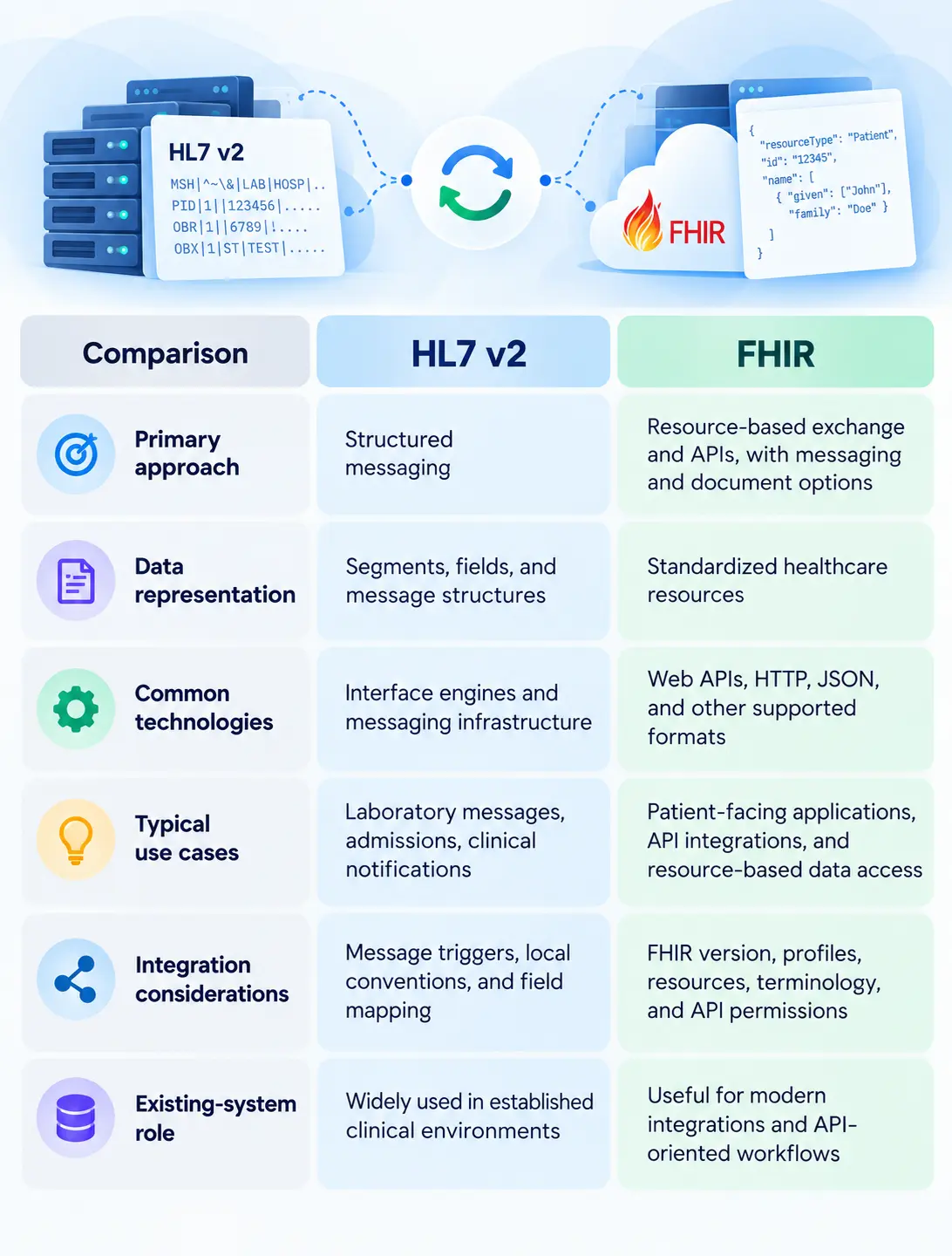
- HL7 v2 is widely used for exchanging clinical and administrative messages, including laboratory orders, results, admissions, and patient movements.
- FHIR provides a modern framework for representing and exchanging healthcare information using standardized resources and web technologies, including APIs.
Organizations should choose the relevant standard based on their existing systems, workflows, integration requirements, and applicable implementation specifications.
What is HL7 v2, and where is it used?
HL7 v2 is a messaging standard commonly used to exchange information between healthcare applications. For example, when a hospital orders a laboratory test, an HL7 v2 interface may transmit the order to the laboratory information system. When the test is completed, another message may return the result to the hospital.
HL7 v2 messages contain segments and fields that represent different pieces of information. Systems interpret those messages according to the relevant message structure and implementation requirements.
Common HL7 v2 use cases include:
- Laboratory orders and results
- Patient admission, discharge, and transfer notifications
- Patient registration and demographic updates
- Clinical workflow notifications
- Communication between EHRs and ancillary systems
HL7 v2 remains important in many healthcare environments because established clinical systems continue to rely on it.
However, different implementations may use different message types, optional fields, local codes, and interface conventions. Integration therefore requires more than simply enabling message transmission.
What is HL7 FHIR?
Fast Healthcare Interoperability Resources, commonly called FHIR, is an HL7 standard for exchanging electronic healthcare information.
FHIR represents healthcare information through standardized resources, such as Patient, Observation, Encounter, MedicationRequest, and Condition. These resources can be exchanged using supported interaction patterns, including RESTful APIs, messaging, and document-based exchange.
For example, a patient-facing application may use an authorized FHIR API to retrieve supported information from an EHR.
FHIR helps developers build healthcare integrations using familiar web technologies while maintaining a common model for health information.
However, FHIR alone does not guarantee that two systems will exchange every data element in the same way. Implementations may differ in supported resources, profiles, terminology bindings, API operations, and authorization policies.
What is FHIR R4 and how does it work?
FHIR R4, or Release 4, is a published version of the FHIR specification that includes normative content and other elements with different maturity and stability levels.
R4 is relevant to many existing healthcare integrations and implementation guides. However, the appropriate version for a new project depends on the target system, applicable requirements, and supported implementation guide.
Before development begins, teams should confirm:
- Which FHIR release the target system supports.
- Which implementation guide and profiles apply.
- Which resources and API operations are available.
- Which terminology systems and value sets are required.
- Which authentication and authorization mechanisms are supported.
Choosing a FHIR version based only on its release date can create unnecessary compatibility problems. The correct choice is the version that meets the project’s actual interoperability requirements.
What is C-CDA and when is it used?
Consolidated Clinical Document Architecture (C-CDA) is a standard for representing and exchanging clinical documents. It is useful when healthcare organizations need to share structured clinical summaries rather than exchange individual data elements through separate API requests.
A clinical document may contain information about problems, medications, allergies, procedures, and other relevant aspects of a patient’s care.
C-CDA remains relevant in document-based exchange workflows. It can complement FHIR, depending on the systems involved and the intended use case.
Why Do Healthcare Systems Need Terminology Standards?
Even when two systems exchange data using compatible formats, they may represent clinical concepts differently. Terminology standards help address this problem.
Common examples include:
- SNOMED CT: Supports consistent representation of clinical concepts.
- LOINC: Provides codes for laboratory tests and other observations.
- RxNorm: Supports normalized representation of clinical drugs in the United States.
These standards serve different purposes and should not be treated as interchangeable.
For example, a laboratory system may identify a test using a local code, while the receiving EHR expects a recognized LOINC code. A mapping process can translate the local representation into the appropriate standardized concept, subject to validation.
Terminology mapping is essential because a code that looks technically correct may still represent a different clinical concept.
HL7 vs FHIR: Key Differences & Use Cases
HL7 v2 and FHIR are both used for healthcare interoperability, but they support different approaches to exchanging information.
The choice is not always one or the other. Many healthcare organizations need both.
EHR Interoperability & System Integration Explained
EHR interoperability is the ability of electronic health record systems to exchange and meaningfully use patient information across applications, providers, and organizations.
An EHR may contain clinical notes, diagnoses, medications, allergies, laboratory results, procedures, and other patient information. Interoperability helps make relevant information available to authorized users and systems when needed.
EHR Integration vs. Healthcare Interoperability
These terms are related, but they are not identical.
EHR integration is the technical process of connecting an EHR to another application or system.
Healthcare interoperability is the broader capability to exchange and use information meaningfully across systems and organizations.
An EHR integration may transfer data successfully while still failing to achieve meaningful interoperability if the data is incomplete, incorrectly mapped, or unavailable in the intended workflow.
Common EHR Integration Methods
Healthcare organizations can connect EHRs with other applications through several approaches.
- FHIR APIs: Allow applications to access supported healthcare resources according to the API’s capabilities and access policies.
- HL7 v2 interfaces: Exchange structured messages for workflows such as laboratory results, orders, and patient movements.
- Clinical documents: Support the exchange of structured summaries and other document-based information.
- Integration engines: Route, transform, validate, and monitor information moving between multiple healthcare applications.
- Health information exchange networks: Facilitate information exchange across participating organizations under defined technical, contractual, and governance frameworks.
The appropriate method depends on vendor capabilities, existing infrastructure, data requirements, and the workflow being supported.
For example, a health-tech company developing a remote patient monitoring application may need to integrate device observations with an EHR. The project team would need to assess device data formats, patient matching, FHIR resource support, terminology mapping, consent, and the receiving system’s capabilities before selecting an integration approach.
The goal is not to make every AI workflow slow. Instead, organizations should design risk-based human oversight.
Make Healthcare Data Exchange Simpler.
Let’s explore an integration approach that fits your technical requirements.
How Healthcare Data Exchange Works: A Practical Example
Imagine a patient receives a blood test at an external laboratory. The patient’s primary care provider needs to review the result in the EHR.
How can interoperability support this workflow?
Step 1: The laboratory generates the result
The laboratory information system records the test, result, measurement units, relevant timestamps, and other available information.
Step 2: The system prepares the data for exchange
The result is represented in a format supported by the receiving system and the agreed interface.
Depending on the architecture, this may involve an HL7 v2 message, a FHIR Observation resource, or another supported exchange mechanism.
Step 3: The integration layer processes the information
The integration layer may validate required fields, map local codes to standardized terminology, transform the data format, and identify the intended destination.
If the message is incomplete or contains an invalid code, the system should detect the problem rather than silently accept incorrect information.
Step 4: The receiving system validates and processes the result
The EHR checks the incoming data against its interface requirements and applicable business rules.
Patient matching is particularly important at this stage. A technically valid result must be associated with the correct patient before it can be used safely.
Step 5: The result becomes available in the appropriate workflow
After successful processing, the result can be made available to authorized users according to the receiving system’s workflow and access policies.
The integration should also support monitoring, error handling, and traceability so that failed messages and processing issues can be investigated.
What does this example demonstrate?
Healthcare data exchange involves more than moving information between two systems. It requires compatible data structures, accurate mappings, patient identity checks, security controls, and reliable processing.
These considerations should be included from the beginning of an interoperability project, not added after the first interface is built.
US Healthcare Interoperability Standards & Regulations in 2026
Healthcare interoperability in the United States involves technical standards, data specifications, exchange frameworks, certification requirements, and legal obligations.
Understanding the differences helps organizations plan integrations without assuming that one standard or regulation addresses every requirement.
What Is USCDI Version 7?
The United States Core Data for Interoperability (USCDI) defines a standardized set of health data classes and data elements for interoperable exchange.
USCDI Version 7 was released on July 23, 2026, and adds data elements intended to advance interoperability for patient care, including elements related to adverse events and safety.
USCDI helps establish a common understanding of which health data elements are included in applicable interoperability specifications. It is not itself a transport protocol or a replacement for FHIR.
Organizations should verify which USCDI version and data requirements apply to their specific certification, regulatory, or implementation context.
What Is TEFCA?
The Trusted Exchange Framework and Common Agreement (TEFCA) is a US framework intended to support nationwide health information exchange through participating networks and defined trust and interoperability requirements.
TEFCA addresses the broader conditions under which participating organizations exchange information. It is not simply another data format or API specification.
For healthcare organizations, participation and integration decisions may involve technical connectivity, applicable agreements, permitted purposes, identity and access requirements, and network-specific implementation considerations.
What Role Do Health Information Exchanges Play?
Health information exchanges (HIEs) help participating healthcare organizations share health information across organizational boundaries.
Depending on the network and implementation, an HIE may support information discovery, document exchange, clinical data sharing, or other exchange workflows.
An HIE can reduce the need for organizations to build every connection independently. However, participation does not eliminate the need to understand data quality, access policies, patient matching, and technical compatibility.
How Does the 21st Century Cures Act Relate to Interoperability?
The 21st Century Cures Act established a federal framework that includes provisions addressing interoperability and information blocking.
Information blocking generally concerns practices that are likely to interfere with access, exchange, or use of electronic health information, subject to the applicable legal definitions and exceptions.
Organizations should not assume that every delay or restriction automatically constitutes information blocking. The relevant facts, actors, exceptions, and regulatory requirements matter.
What Are the Relevant CMS Interoperability Requirements in 2026?
The Centers for Medicare & Medicaid Services (CMS) has established interoperability and prior authorization requirements for specified categories of health plans and programs.
The 2024 CMS Interoperability and Prior Authorization Final Rule (CMS-0057-F) includes requirements related to Patient Access, Provider Access, Payer-to-Payer, and Prior Authorization APIs for impacted payers.
Some operational provisions and reporting requirements began in 2026, while many API implementation requirements generally have compliance dates beginning January 1, 2027, depending on the payer type and provision.
CMS also issued a proposed rule in 2026 addressing interoperability standards and prior authorization for drugs. Proposed provisions should not be presented as final requirements.
Healthcare organizations and vendors should verify the applicability and timing of each requirement before planning a compliance-related implementation.
How Does HIPAA Affect Healthcare Data Exchange?
HIPAA establishes privacy and security requirements for covered entities and business associates within its scope.
Healthcare interoperability solutions must account for applicable privacy, security, and permitted-use obligations. Depending on the system and context, relevant safeguards may include access controls, authentication, audit logging, risk analysis, secure transmission, and incident response.
However, using FHIR, an API, or an encrypted connection does not automatically make an application HIPAA-compliant.
Organizations need to evaluate the complete environment, including policies, contracts, data flows, technical safeguards, and operational practices.
Common Healthcare Interoperability Challenges and How to Solve Them
Even when healthcare systems support recognized standards, implementation can be complex. Understanding the common challenges helps teams plan realistic integration projects.
Legacy Systems and Incompatible Interfaces
Older clinical applications may rely on established messaging formats, custom interfaces, or vendor-specific data structures.
How to address it: Assess existing interfaces before choosing a new architecture. Use an integration layer where appropriate to route, transform, and validate information between legacy systems and newer applications.
Inconsistent Data Formats and Clinical Terminology
Different systems may represent the same clinical concept using different codes, units, field names, or data structures.
How to address it: Define mapping rules, use appropriate terminology standards, validate incoming data, and maintain mappings as source systems and requirements change.
Patient Identity Matching
A patient may have different identifiers across hospitals, clinics, laboratories, and health plans.
Incorrect matching can associate information with the wrong record, while failed matching can leave useful information disconnected.
How to address it: Establish patient-matching rules, validate identifiers, define exception-handling procedures, and use appropriate identity-management capabilities. Ambiguous matches should be reviewed rather than treated as certain.
Incomplete or Poor-Quality Data
A system may exchange data successfully but still receive missing values, outdated records, duplicate entries, or inconsistent timestamps.
How to address it: Define data-quality rules, validate required fields, preserve source information where appropriate, and monitor recurring data issues.
Privacy, Access Control, and Cybersecurity Risks
Connecting more systems can create additional interfaces, credentials, access paths, and potential security risks.
How to address it: Apply appropriate authentication and authorization, least-privilege access, secure transmission, audit logging, secrets management, and ongoing security monitoring. Review the full data flow and applicable compliance requirements.
Vendor Limitations and Integration Costs
An EHR vendor may support only specific API operations, implementation guides, or interface options. Licensing, testing environments, interface configuration, and maintenance can also affect project cost.
How to address it: Confirm vendor capabilities and commercial requirements early. Document dependencies, estimate integration and testing effort, and include post-launch support in the project plan.
Clinical Workflow Disruption
An integration can be technically successful but still create extra work for clinicians if information appears in the wrong place or arrives at the wrong time.
How to address it: Involve clinical and operational stakeholders in requirements gathering and testing. Validate not only whether data arrives, but whether it supports the intended workflow.
What Are the Benefits of Healthcare Interoperability?
Well-designed interoperability can improve how healthcare organizations access, exchange, and use information.
- Better Access to Patient Information
Authorized healthcare professionals can access relevant information from connected systems, helping reduce dependence on fragmented records and manual requests.
- Improved Care Coordination
When providers can access relevant clinical information across care settings, they have a stronger foundation for coordinating treatment and follow-up.
The actual benefit depends on data completeness, timeliness, system usability, and the clinical workflow.
- Less Manual Data Entry
Automated data exchange can reduce repetitive entry and transcription between connected applications. This can help teams spend less time moving information manually.
Automation still requires validation, exception handling, and appropriate review.
- Better Support for Population Health and Reporting
Consistent data structures and terminology can help organizations aggregate and analyze information across sources.
Interoperable data can support reporting, quality measurement, and population health workflows when the underlying data meets the requirements of the intended use.
- A Stronger Foundation for Healthcare AI
Healthcare AI applications depend on access to relevant, reliable, and appropriately governed data.
Interoperability can help connect information from EHRs, laboratory systems, patient-facing applications, and other sources. However, connected data is not automatically suitable for AI.
Organizations must also address data quality, provenance, privacy, security, validation, and the risks of incomplete or misleading information.
How to Implement Healthcare Interoperability: A Step-by-Step Roadmap
Planning a healthcare interoperability project? Start with the workflow and data requirements rather than selecting a technology first.
The following roadmap can help healthcare organizations and product teams structure the implementation.
Step 1: Assess Existing Systems and Data Flows
Identify the systems involved, what information they hold, how they currently exchange data, and where manual processes or failures occur.
Document source and destination systems, vendor interfaces, data ownership, dependencies, and known limitations.
Step 2: Define Business and Clinical Requirements
Determine which workflows the integration must support.
For example, does the project need to exchange laboratory results, retrieve patient history, synchronize medication information, or support prior authorization?
Define success in measurable terms, such as data completeness, successful processing, acceptable latency, error rates, and workflow usability.
Step 3: Select the Standards and Architecture
Evaluate the supported options, including HL7 v2, FHIR APIs, clinical documents, and integration engines.
Choose based on the existing infrastructure, data requirements, vendor capabilities, applicable implementation guides, and long-term maintenance needs.
Step 4: Establish Data Mapping and Terminology Rules
Document how source fields, codes, units, and identifiers map to the receiving system.
Define validation rules and establish a process for handling unsupported codes, missing values, and ambiguous data.
Step 5: Implement Security and Governance
Determine who can access the information, under which conditions, and for what purpose.
Address authentication, authorization, auditability, data minimization, and applicable privacy and security requirements before production deployment.
Step 6: Test the Complete Integration
Testing should cover more than a successful API response or message transmission. Include:
- Data mapping and terminology validation.
- Patient identity matching.
- Missing, duplicate, and malformed data.
- Authentication and authorization failures.
- Network interruptions and retry behavior.
- Audit logs and error reporting.
- Performance under expected workloads.
- Clinical workflow validation with appropriate stakeholders.
Use synthetic or appropriately authorized test data and environments suited to the project’s privacy and security requirements.
Step 7: Deploy, Monitor, and Maintain
Roll out the integration in a controlled manner and monitor its behavior after deployment.
Track failed transactions, processing delays, data-quality issues, interface changes, and unexpected access patterns.
Healthcare interoperability is an ongoing capability, not a one-time development task. Vendor updates, changing requirements, and new workflows may require continued maintenance.
How to Choose the Right Healthcare Interoperability Solution
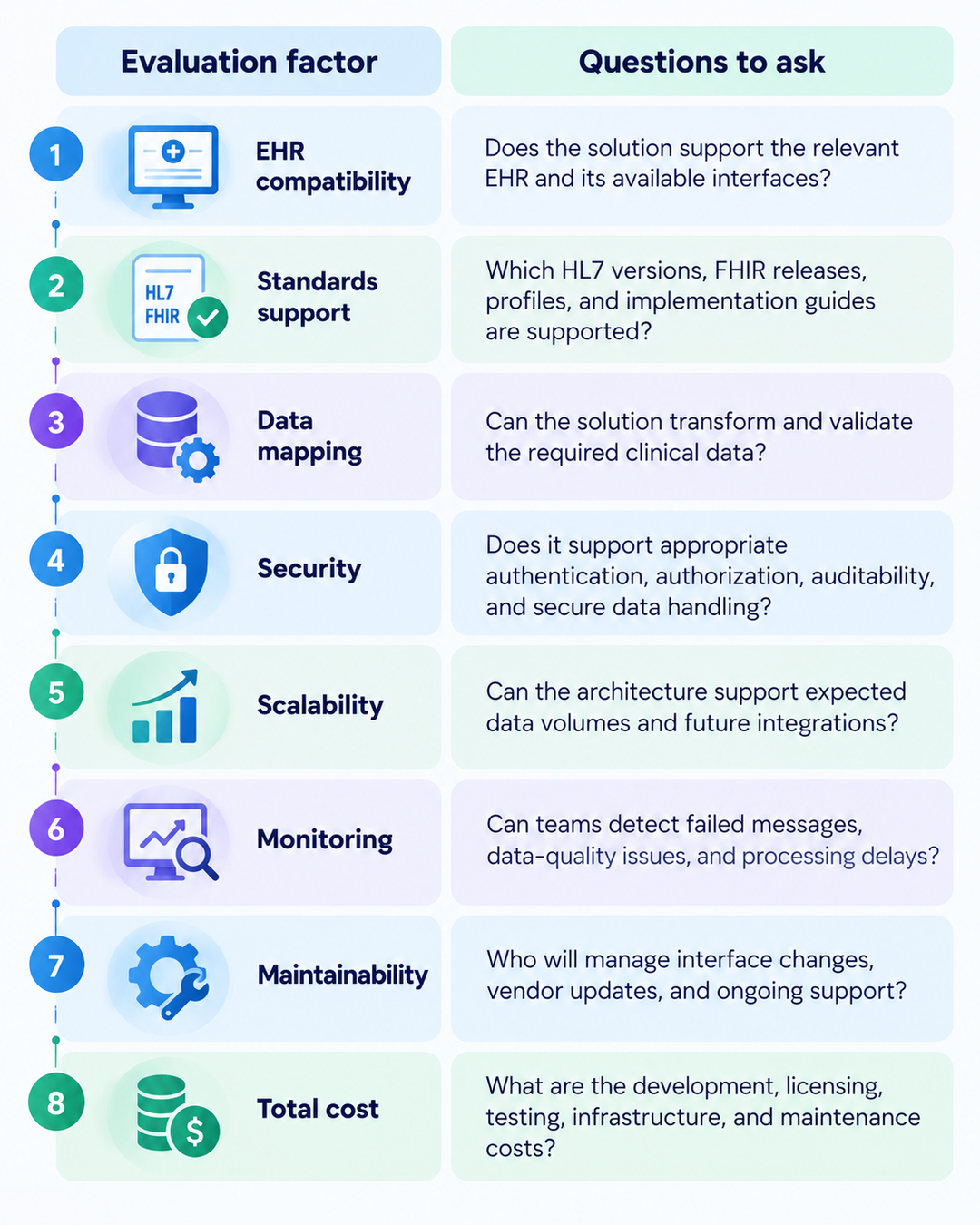
The right solution depends on your organization’s existing infrastructure, integration requirements, internal capabilities, and long-term goals. Before selecting a vendor or development approach, evaluate the following factors.
The Future of Healthcare Interoperability Beyond 2026
Healthcare interoperability continues to evolve as organizations adopt API-based exchange, modernize legacy systems, and connect more digital health applications.
Several developments deserve attention.
Broader Use of API-Based Data Exchange
FHIR-based APIs support a range of healthcare application use cases, including patient access, data retrieval, and integration with digital health products.
The practical opportunities depend on the supported resources, implementation specifications, access policies, and capabilities of the connected systems.
Interoperability for Digital Quality Measurement
FHIR-based data models and implementation guides are supporting work to modernize digital quality measurement.
Standardized clinical data can help connect quality measurement and clinical workflows, although organizations still need to meet the specific requirements of applicable measures and reporting programs.
AI-Assisted Data Processing
AI may help with extracting information from unstructured documents, identifying potential mapping issues, and assisting with data-quality workflows.
These applications require appropriate validation, monitoring, and human oversight where needed. AI should not be treated as a substitute for established standards, reliable source data, or clinical judgment.
More Connected Patient Experiences
As healthcare organizations connect EHRs, patient portals, monitoring devices, and other applications, interoperability can help support more continuous access to relevant information.
Achieving this requires coordinated technical design, data governance, privacy protections, and attention to how information is used across care settings.
The broader direction is clear: healthcare organizations need systems that do more than store information independently. They need reliable ways to make the right information available to the right people and applications at the right time.
Conclusion
Healthcare interoperability enables secure, meaningful data exchange across healthcare systems. By combining HL7, FHIR, EHR integration, and effective data governance, organizations can improve data accessibility, streamline workflows, and build scalable digital healthcare solutions.
At Genius Bytes, we help businesses develop healthcare software aligned with their technical and operational needs.
Planning an EHR integration or healthcare software project? Contact Genius Bytes to explore the right solution for your organization.
Modernize Your Healthcare Software
Build connected healthcare applications with an approach designed around interoperability, data quality, security, and scalability.
FAQs
HL7 FHIR interoperability is the ability of healthcare systems to exchange and use health information through the Fast Healthcare Interoperability Resources (FHIR) standard developed by HL7 International. FHIR uses standardized resources and supports APIs and other exchange methods to help applications share clinical data consistently.
FHIR (Fast Healthcare Interoperability Resources) is a healthcare data exchange standard that defines how information, such as patient records, medications, diagnoses, and laboratory results, can be represented and shared between systems. It helps developers build connected healthcare applications using standardized data structures and web technologies.
The four commonly recognized levels of healthcare interoperability are foundational, structural, semantic, and organizational interoperability. Foundational interoperability enables data exchange, structural interoperability defines data organization, semantic interoperability ensures consistent interpretation, and organizational interoperability aligns policies and workflows between participating organizations.
HL7 International is the standards organization that develops healthcare interoperability standards. HL7 v2 is a messaging standard widely used for clinical workflows, while FHIR is a standard for representing and exchanging healthcare information through resources and supported interactions, including APIs. Both can work together in a healthcare integration architecture.
Not necessarily. HL7 v2 remains widely used in existing healthcare systems, particularly for laboratory results, patient admissions, and clinical messaging. FHIR supports modern API-based integrations and resource-oriented data exchange. Many organizations use both standards, selecting the appropriate approach based on system capabilities, workflow requirements, and modernization goals.
The choice depends on integration complexity, existing systems, budget, scalability, and maintenance requirements. Custom integration offers greater control over specific workflows, while an interoperability platform may provide reusable interfaces, data transformation, and monitoring capabilities. A hybrid approach can also work well. Assess total cost, security, vendor compatibility, and long-term support before deciding.
EHR interoperability is the ability of electronic health record systems to exchange and meaningfully use patient information across healthcare providers and applications. It helps authorized users access relevant clinical information, such as medications, allergies, diagnoses, and laboratory results, across connected systems.
Common challenges include legacy systems, incompatible data formats, inconsistent clinical terminology, patient identity matching, poor data quality, security risks, and vendor limitations. Organizations can address these challenges through standards-based integration, data mapping, validation, access controls, thorough testing, and continuous monitoring.
Healthcare systems exchange patient data through supported interfaces, such as HL7 messages, FHIR APIs, and clinical documents, combined with appropriate authentication, authorization, encryption, access controls, and audit logging. Organizations must also address patient identity, data quality, and applicable privacy and security requirements, including HIPAA where relevant.
FHIR APIs enable healthcare applications to access, exchange, and manage supported health information using standardized FHIR resources and interactions. They can support integrations between EHRs, patient portals, healthcare applications, and other systems. Their capabilities depend on the FHIR version, implementation guides, supported resources, and access permissions.